
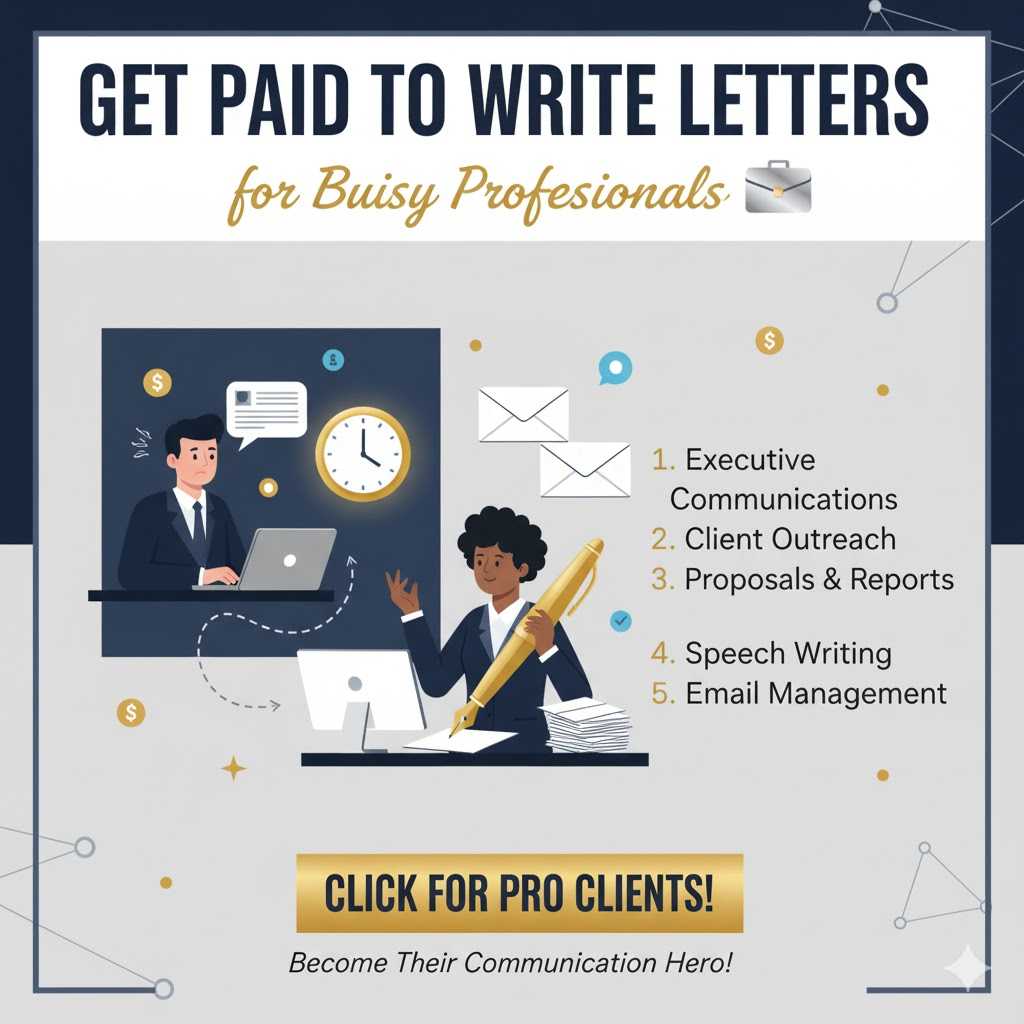
In an era of rapid emails, instant messages, and even voice notes, there remains a very human need that cannot be fully replaced by automation: the personal, thoughtful written letter. While many busy professionals are swimming in meetings, emails, and deadlines, they often lack the time—or sometimes even the inclination—to craft meaningful correspondence. That’s where you step in. If you’re a writer with a flair for clarity, tone, and polished communication, you can turn that skill into money by offering a service: writing letters for busy professionals.
In this article, I’ll walk you through why letter writing side hustle is promising, what kind of letters you can write, how to get started (even with zero clients), how to set your rates and structure your service, best practices to deliver quality work, and how to scale over time. The goal: help you build a side hustle (or even full-time service) that’s engaging, professional and built for the future.
Why this is a smart niche right now?
1. Professionals are strapped for time
Modern professionals get interrupted constantly—back‐to‐back meetings, Slack and Teams messages, mobile notifications, travel and more. They often should send thank-you letters, formal correspondence, client or partner outreach letters, but they simply don’t have the bandwidth. Good business-writing guides emphasise brevity, clarity and courtesy precisely because busy professionals appreciate communication that respects their time.
2. Letters—yes, and emails too—still matter
Although “writing letters” may conjure vintage images, in reality “letter” here includes formal and semi-formal correspondence: thank-you letters after meetings, follow‐up letters, partner / investor thank-yous, letters of introduction, personal branding letters, or even client/employee appreciation letters. The medium might be email or printed letter but the craft remains. According to professional writing resources, business letters must be concise, clear, and correct.
3. Many professionals outsource writing tasks
Outsourcing writing—reports, blogs, newsletters—is already common. But even more so: professional leaders will happily delegate a well-written letter because it’s visible, high-stakes, and reflects their personal image. If you can deliver polished, on-brand letters quickly, you’re offering strong value.
4. Low barrier to entry, high value per client
Writing letters costs you little in terms of equipment, location or overhead. But the perceived value to the client is significant: helping a CEO send a compelling introduction letter or a partner letter could save them hours and improve outcomes. Therefore, you can command a decent rate for what you do.
5. SEO and online demand are there
While there are many resources on how to write business letters, templates and guides, fewer people are offering the service of writing personalized letters for busy professionals. That gap means an opportunity for you to position yourself and rank well in search. You can target keywords like “professional letter writing service”, “business correspondence writer”, “outsource thank you letter CEO”, etc.
What types of letters you can write?
To build a robust service offering, it’s helpful to map out the various kinds of letters busy professionals might need. Here are key categories:
- Thank-you / appreciation letters
- After meetings, partnerships, events or client engagements.
- These letters help build relationships. Templates exist but personalization wins.
- Introduction / networking letters
- A professional wants to reach out to someone new (investor, partner, potential client) and needs a thoughtful letter that opens doors.
- Follow-up / reminder letters
- Suppose a meeting ended, next steps agreed, but the follow-up letter needs to reinforce the conversation, clarify deliverables, set tone.
- Resignation / appreciation for employees or team letters
- Executives or managers might need to send farewell letters, appreciation letters, or letters announcing transitions.
- Client or stakeholder correspondence
- Letters addressing issues, invitations to collaborate, or formal notifications. These require good tone, clarity, and sometimes a formal structure.
- Personal brand / founder letters
- Founders or professionals might want a letter that speaks to their network, introducing themselves, their vision, seeking connections. This is more narrative than standard business letters.
- Printed archival letters
- Some professionals like a high-quality printed version (on letterhead) for important communications—so you might offer formatting, printing or design as an upsell.
By offering a suite of letter types, you increase your client pool and present yourself as the “go-to correspondence writer” for busy professionals.
How to get started from zero?
Step 1: Hone your letter-writing craft
Even if you’re a good writer, writing for busy professionals demands certain skills: clarity, brevity, correct tone, strong formatting, and the ability to personalize. Resources in business writing emphasise: lead with your main point, keep sentences short, respect the reader’s time.
You might want to:
- Read up on structure of professional letters (salutation, opening, body, closing).
- Practice rewriting letters or creating sample letters for each category above.
- Build 2-3 portfolio samples: e.g., a follow-up meeting letter, a thank-you letter, an introduction letter.
Step 2: Define your service offering & pricing
You’ll want a clear menu of services and pricing. For example:
- Basic letter (300–400 words) including one revision.
- Premium letter (500–700 words) with personalization, branding, print version.
- Subscription/retainer model: monthly bundle of 3 letters for busy professionals.
Decide on your hourly or flat-rate basis. Because the value to the client is high and time cost to you is manageable, you can charge accordingly. For example: “$75 for one letter”, “$200 for premium letter plus printed version”.
Step 3: Create your marketing presence
- Website / landing page: Use keywords like “professional letter writing service for executives”, “business correspondence writer”, “get paid to write letters for professionals” (note: this also helps your SEO).
- Portfolio page: Show sample letters (with sensitive details removed) and results (e.g., “Client closed partnership after sending the letter”).
- Testimonials: Once you have clients, gather quotes about how your letters made an impact.
- Blog / content: Write posts such as “Why busy CEOs still need to send letters”, “How to write a follow-up letter after a meeting” etc., to target SEO and build authority.
- Social media / LinkedIn: Target professionals, VPs, CEOs, business owners. Share value-added content: tips on letter writing, time-saving communication.
- Outreach: Contact professionals who might need your service: executive assistants, startup founders, consultants. Offer a sample or discount.
Step 4: Find your first clients
Some channels to get initial paying clients:
- Freelance platforms (Upwork, Fiverr) but emphasise premium service and positioning.
- LinkedIn outreach: connect with executives, assistants, and offer “I help busy professionals send polished letters without lifting a finger”.
- Local business network: in your city or region, professionals may still prefer someone local.
- Cold email: craft a short letter yourself offering your service, showing the value (“You are busy; let me craft the perfect letter your partner will remember”).
- Referrals: once you begin working with one client and deliver excellent service, ask them to refer others.
Offer a “first-letter discount” or “free revision” to reduce friction.
Setting your rates and structuring workflow
Factors to consider in pricing
- Complexity: How much personalization, research, tone adaptation? A letter to a potential investor will require more care than a basic thank-you note.
- Word count: Longer letters = more time.
- Revision rounds: Include a standard number of revisions; extra will cost more.
- Turnaround time: A rush job (24 h) should cost extra.
- Format: Printed letter, special stationery, luxury elements = upsell.
- Retainer vs single project: Regular clients can pay a monthly fee for recurring letters.
Sample pricing structure (you’ll adjust for your market)
- Basic email/letter (300 words, 1 revision): USD 50
- Standard letter (500 words, 2 revisions, personalized tone): USD 100
- Premium letter (700-800 words, full personalization, print version formatted): USD 200
- Retainer: Up to 3 letters per month, up to 500 words each: USD 250 per month
Workflow recommendations
- Client briefing: Ask for the letter’s purpose, recipient, tone, key message, any background.
- Research & draft: Write the letter, ensure purpose is clear from first paragraph (see BLUF/“Bottom Line Up Front” principle).
- Client review: Send draft; get feedback.
- Revision: Apply changes; polish grammar/format.
- Delivery: Provide final version in both Word/Google Docs and PDF for print/email. Optionally, arrange printing.
- Follow up: After some time, check with client for feedback—did the letter produce the intended result? This allows you to use it for testimonials.
Best practices to deliver high-quality work
Respect the reader’s time
Busy professionals don’t want long, rambling letters. Your letter should be concise, direct, and to the point. Use short paragraphs, clear headings (if appropriate), and emphasize main message early.
Tone matters
You must adapt tone to the client, purpose and recipient. For instance:
- A friendly thank-you might be “Warm regards, [Name]” with a conversational tone.
- A formal introduction letter might require “Dear Ms X,” and formal structure.
- If the recipient is senior, use respectful language, and avoid slang.
Professional writing guides emphasise correctness: proper grammar, punctuation, and format.
Structure and formatting
- Use standard fonts (Arial, Times New Roman), size 11 or 12.
- Clear margins, left-aligned text, blank lines between paragraphs.
- Include date, sender address, recipient address (if print).
- Use salutation, body, closing properly.
- If bullet points or numbered lists help break down multiple points, they’re acceptable especially when clarity is needed.
Customize for client branding
Ask for the client’s letterhead (if print), branding guidelines, preferred tone, any prior communications with the recipient. Make sure the letter aligns with the client’s voice.
Provide value beyond the words
- Optionally provide summary or subject line for email versions.
- You might create a folder or repository of letters for clients (so they have past versions).
- Offer suggestions: e.g., “Consider following up in two weeks with a short call” or “Attach your one-pager to reinforce this letter’s message”.
Maintain confidentiality and professionalism
You’ll be writing on behalf of someone else; guarantee privacy and confidentiality. Use a contract or service agreement specifying deliverables, usage rights, and confidentiality.
How to market, grow and scale your service?
SEO and content marketing
Since you want to rank on Google and attract clients globally or locally, here are strategies:
- Write blog posts targeting keywords: “business letter writing service”, “professional correspondence writing for executives”, “how to outsource letter writing”, etc.
- Use long-tail keywords: “get paid to write letters for busy professionals”, “executive letter writing service India” etc.
- Optimize metadata: title tags, meta descriptions featuring your primary keyword.
- Include case studies/testimonials on your website: “How I helped a startup founder send 50 investor follow-up letters in one month”.
- Guest-blog or collaborate with professional services blogs: e.g., executive assistants forums, startup blogs discussing productivity.
- Use social media (LinkedIn especially) to share tips (e.g., “3 Things to include in a thank-you letter after meeting a potential partner”). That builds authority and brings traffic.
Outreach & partnerships
- Partner with executive assistants, VA agencies. They might refer their executives to you.
- Collaborate with branding agencies: if they help the founder with branding, you can offer the letter service as part of “founder communications”.
- Offer webinars or workshop: “How to write letters that get read by busy executives”. This builds credibility.
Upselling and recurring models
- Offer printed & mailed version of letters. Some professionals still appreciate a physical letter.
- Offer packages: say “Monthly correspondence bundle”—3-5 letters per month at a discounted rate.
- Offer a subscription maintenance service: review and refresh older correspondence templates for the client.
- Provide training for the client or their team: “Letter writing 101 for busy professionals” as an add-on.
Automate/Outsource parts for scale
As you grow:
- Create a template library for common types of letters (thank you, introduction, follow-up).
- Use software (with manual oversight) to maintain version control and client records.
- Hire freelance writers to help with volume, while you manage tone/quality and final editing.
- Implement a CRM to manage clients, deadlines, billing.
Common challenges and how to overcome them
Challenge: Clients unsure of what they want
Solution: Use a detailed briefing form. Ask for: recipient role, key message, tone, any past letters, deadline, purpose. Give clients guidance/examples if needed.
Challenge: Tight deadlines / last-minute requests
Solution: Build buffer into your schedule. Charge a rush fee (e.g., +50% for turnaround under 24 h).
Set realistic deadlines and stick to them.
Challenge: Tone mismatch or revision creep
Solution: Define number of revisions in the contract. Provide initial draft with clear ask “Please review and identify changes by [date]”.
Maintain consistent tone guidelines for each client: keep a “style sheet” for each client (preferred salutations, closings, any do-not-use terms).
Challenge: Getting paid / chasing invoices
Solution: Use clear contracts, require partial payment (50%) before work starts, or payment via reliable payment gateway (PayPal, bank transfer).
Send invoice immediately upon delivery and follow up politely.
Challenge: Finding clients
Solution: Consistent outreach. Offer initial discounted or even free letter to build portfolio/testimonial. Use LinkedIn, content marketing, partnerships with VAs/executive assistants.
Example workflow: From first inquiry to delivery
- A client (executive) contacts you: “I need a letter to follow up after a strategic partnership meeting. The partner is a large firm in Germany; the tone should be professional but warm; we want to propose next steps.”
- Send a briefing form: ask for meeting notes, key outcomes, duration, purpose of letter, client branding.
- Confirm price and timeline (e.g., USD 100, 48-hour turnaround).
- Draft letter: First paragraph restates purpose; second paragraph recaps meeting and key points; third paragraph proposes next steps and timeline; closing expresses appreciation and invitation to respond.
- Client reviews; you apply one revision.
- Deliver final version (PDF + Word). Offer optional print & mail service.
- After one week you follow up: “Did the partner respond? Was the letter effective?” Use feedback as testimonial.
Why you can get paid – and will your offering stay relevant?
Because you’re offering something that’s not easily automated or outsourced to cheap labour completely: the craft of tone, personalization, understanding the recipient’s psychology, and aligning with the client’s brand voice. While AI tools can generate letters, they lack nuance, context and the personal brand alignment you provide. And busy professionals value time saved and quality output more than lowest cost.
Moreover, as remote and hybrid working continues, professionals still need high-impact written communication—letters (printed or digital) remain part of business etiquette. By positioning yourself as a specialist correspondence writer for busy professionals, you distinctively meet need and add value.
Final thoughts:
If you’re reading this and thinking, “Yes—I can do this,” good. Now pick one action today:
- Draft your service offering and create three letter samples.
- Set up a simple landing page (Google Sites / WordPress) with your service, portfolio and contact.
- Reach out to one potential client or partner (VA, executive assistant) and pitch your service.
- Write a blog post targeting your ideal keyword: e.g., “Why busy professionals outsource their letter writing.”
With consistent effort, you can build a steady stream of clients. The key: deliver high-quality, on-time, personalized letters that reflect your client’s voice and respect the recipient’s time. Do that well, and word-of-mouth will bring more business.
